Expressionist Theater: The Stage as an Era's Scream
Expressionist theater shaped the years from about 1910 to 1925 and changed ideas about what a stage should show. Instead of depicting the world as faithfully as possible, it put tension, fear and revolt in the foreground. How do you recognize such a performance, and how did it differ from earlier theater? This article presents the features of the movement, its most important authors and the design of its stage sets. It also shows why the subject is still worth exploring today.
What Is Expressionist Theater?
In expressionist theater, the inner experience of the main character takes center stage. The authors wanted to express feelings in their pure form and therefore gave up detailed portrayals of the surroundings. Expressionist drama is correspondingly terse and urgent.
Typical features are compression, short station scenes, pathos and a telegram-like style of speech. The characters embody types and often remain nameless, since their role matters more than their biography. On stage, a person in crisis appears more often than a hero with an individual story. The missing names are especially quick to catch the eye when reading or watching.
Many plays took up experiences of the First World War and of life in the big city. The sense of menace found its expression on stage that way. An expressionist scene therefore often sounds more like a scream than a conversation.
Expressionist Drama and Its Authors
Georg Kaiser is among the authors of this movement. His play “From Morn to Midnight” offers a good way in. Readers who watch for compression, short scenes and telegram style will see how these devices work in expressionist drama.
Another important author is Ernst Toller, who wrote the play “Masses and Man” in the 1920s. The title alone points to the central role of the community. It pays to read Toller alongside Kaiser and to compare the two works within the same literary movement.
Frank Wedekind's “Spring Awakening,” staged in Berlin in 1906, is seen as a harbinger of these changes. The play is an early example of the break with norms that later became a mark of expressionism. It shows that the need for a new theatrical language was ripening even before 1910.
What Did the Stage Design Look Like?
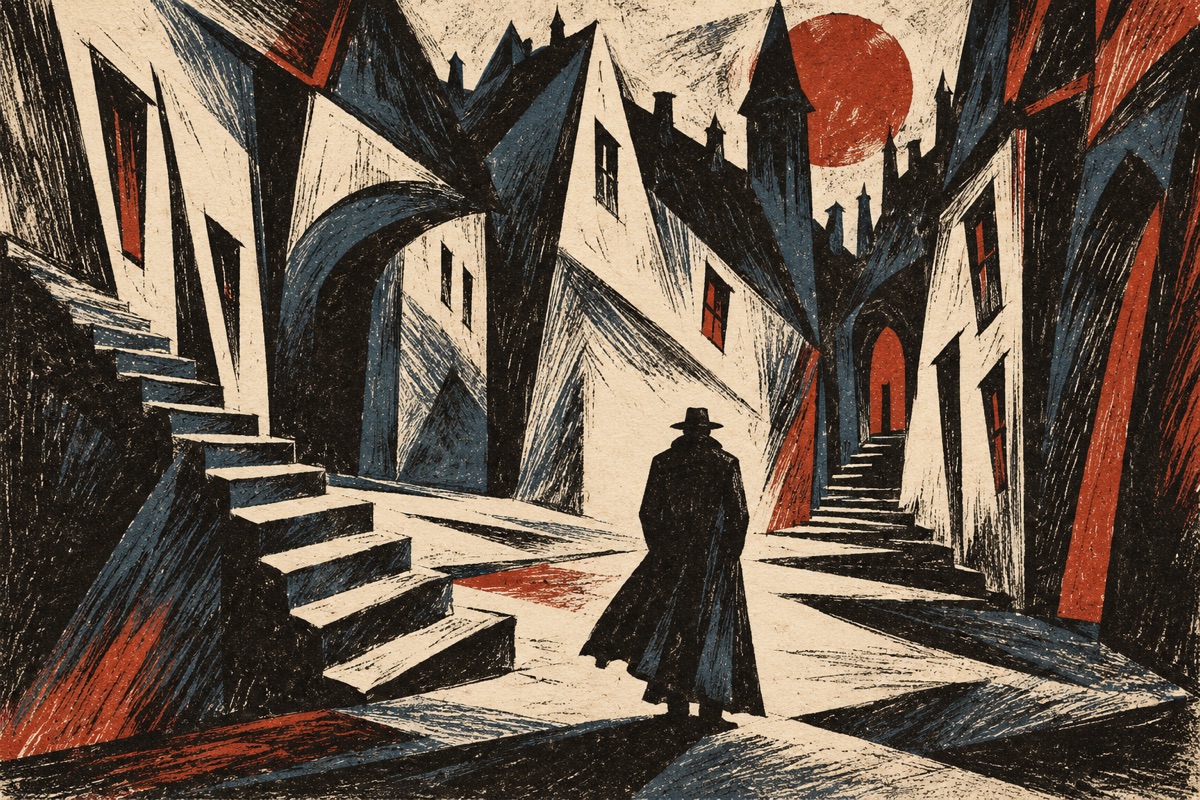
The stage design of expressionist theater was strongly influenced by painting. Light drew shapes, sharp contrasts raised the tension and slanted angles threw the space off balance. The stage itself thus became an expression of unrest.
This design was meant less to depict the setting than to convey the character's state of mind. What the drama put into words, the stage made visible in pictures. It is precisely this union of language and design that sets expressionist theater apart from a stage that merely rebuilds a location.
Expressionist theater can be recognized by the interplay of several features: in the text we meet compression, short scenes, nameless types, pathos and telegram style, and on stage, harsh contrasts and slanted angles.
Why It Is Worth a Look
Expressionist theater shows how fear and collective experience can reach the stage even without realistic scenery. Compression, the type in place of the individual and the station scene are devices best understood through the plays themselves. Kaiser and Toller make good starting points, and a comparison with Wedekind can follow.